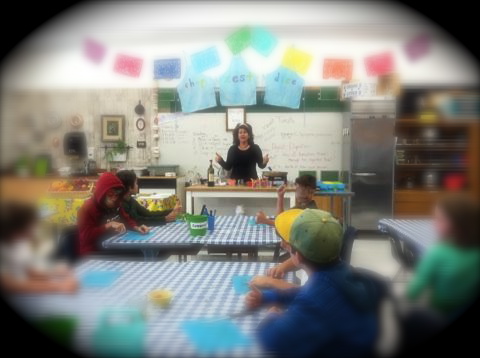
 The idea behind the Science of Cooking Class took shape when two teachers, one part science, and one part cooking, decided to team up and collaborate on a new and exciting approach to teaching science concepts through food, and as a result, The Science of Cooking Class came about.
Each Science of Cooking Class focuses on a nutrition lesson, a cooking lab activity, and a science concept. Students gain practical knowledge and skills by exploring the scientific components of each lesson. A study in the November/December 2011 issue of the Journal of Nutrition Education and Behavior shows how cooking in the classroom successfully helps students learn school subjects and develop cooking skills. Even at the higher educational level, the benefits and importance of combining cooking with an academic subject have become clear.
At Harvard University, the administration encouraged their faculty to create new ideas for courses that connect classrooms to the “life outside,” an experiential approach that students embrace. Offering a course on, The Science of the Physical Universe, Cooking and Science, proved extremely successful at Harvard’s School of Engineering and Applied Sciences. “This course may accomplish what I’ve been trying to do for so many years — make physics interesting, ’’ said David Weitz, Harvard professor of physics and applied physics, who led the course. (Boston Globe, 10/10) “I spent all my life in academia trying to teach physics… Weitz said. “And for the first time students were interested. They wanted to learn—they enjoyed it.” (Harvard Crimson, 12/10/10)
This month, the featured topic in the Science of Cooking Class for fourth graders, focused on how the electrolytes from a pear play a key role in sending signals to our muscles, brain, and heart. To illustrate the point, we showed how a pear uses its electrolytes to conduct an electrical charge from two different metals to make an electrical circuit, highlighting a science lesson on magnetism and electricity.
Beyond exposing students to the connections that underlie these two subjects, it also creates another dialogue for supporting greater collaboration between teachers of different subjects at school. Plus, the value of integrating science with cooking and how it relates in the classroom offers students both practical skills and conceptual tools that will serve them well in life.
 In cooking class, students discover the historical significance of the Three Sisters–corn, beans, and squash, and their important relationship to each other in the garden through the art of storytelling. Storytelling is a fun and meaningful teaching technique that not only supports literacy efforts in the classroom, but also allows students to apply their knowledge into a different context of learning. It benefits students of all learning styles, encourages imagination, and develops their listening skills. Additionally, the story helps to reinforce a positive attitude towards healthy food, since the underlying theme skillfully integrates the nutritional benefits of the Three Sisters, along with a cooking lab activity that follows.



 Carrie Fehr
